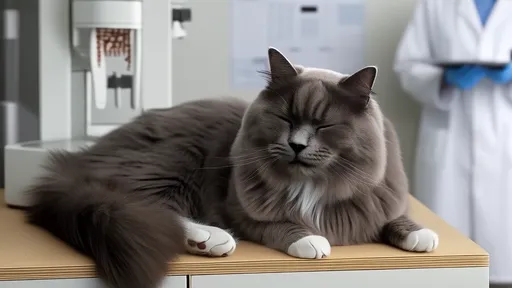
For centuries, the soothing sound of a cat’s purr has been associated with comfort and relaxation. But recent scientific explorations suggest that these low-frequency vibrations might hold unexpected therapeutic potential—particularly in the realm of bone health. Researchers are now investigating whether the frequencies emitted by a cat’s purr could serve as a non-invasive adjunct therapy for conditions like osteoporosis, offering a fascinating intersection between zoology and human medicine.
The idea isn’t as far-fetched as it might seem. Studies in vibrational therapy, or "vibroacoustic therapy," have long explored how mechanical stimulation at specific frequencies can influence cellular activity. Cats naturally purr at frequencies between 20 and 150 Hertz, with a dominant range of 25–50 Hz—a sweet spot that coincidentally overlaps with frequencies shown to promote bone density in clinical studies. This overlap has sparked curiosity: Could exposure to purr-like vibrations mimic the effects of targeted vibrational therapy?
The Science Behind Vibrational Bone Stimulation
Bone is a dynamic tissue, constantly remodeling itself in response to mechanical stress. Weight-bearing exercise, for example, triggers osteoblasts—the cells responsible for bone formation—to strengthen skeletal structure. However, for individuals with osteoporosis or limited mobility, high-impact exercise isn’t always feasible. Here’s where low-frequency vibrations come into play. Laboratory studies have demonstrated that gentle mechanical loading at 20–90 Hz can stimulate bone growth and reduce resorption, even in the absence of traditional exercise.
Researchers at the University of California, Davis, found that mice exposed to 30 Hz vibrations for just 15 minutes daily showed significant improvements in bone density. Similar studies in postmenopausal women—a demographic at high risk for osteoporosis—revealed that whole-body vibration therapy at 30–50 Hz increased bone mineral density over time. These frequencies align strikingly with those of a cat’s purr, raising the provocative question: Could feline companionship double as a therapeutic device?
The Purr Phenomenon: From Folklore to Clinical Potential
Cats aren’t just purring for their humans; the behavior is thought to have evolved as a self-healing mechanism. Veterinarians note that domestic cats purr not only when content but also when injured or stressed. This has led to the "purr hypothesis," suggesting that the vibrations may aid in tissue repair, pain relief, and even fracture healing. If true, the implications for human medicine are profound. Imagine a future where "purr therapy" devices—emulating feline frequencies—are prescribed alongside calcium supplements for osteoporosis patients.
Of course, translating this from hypothesis to clinical practice requires rigorous study. While no trials have yet tested direct exposure to cat purrs for bone health, anecdotal evidence abounds. Elderly cat owners, for instance, often report fewer fractures than statistically expected, though confounding variables like increased physical activity (via pet care) make conclusions elusive. Still, the biomechanical parallels between vibrational therapy and purring are too compelling to ignore.
Practical Applications and Future Directions
For now, scientists are focusing on engineering controlled vibrational devices rather than prescribing cat cuddles. Companies like Marodyne and Juvent have already developed low-intensity vibration platforms designed to improve bone density. These devices operate at frequencies eerily similar to a cat’s purr, delivering gentle oscillations that may stimulate osteoblast activity without the risks of pharmaceuticals or invasive procedures.
Yet, the allure of bio-inspired solutions persists. Some researchers propose hybrid approaches—perhaps pairing traditional vibration therapy with recordings of purring sounds to enhance relaxation and compliance. Others are investigating whether the emotional benefits of pet ownership (reduced stress hormones like cortisol, which can degrade bone) might synergize with vibrational effects. After all, medicine is as much about the mind as it is about the body.
A Purr-fect Complement to Conventional Care
It’s important to stress that purr-frequency vibrations aren’t a standalone cure for osteoporosis. They would likely serve as an adjunct to existing treatments: weight-bearing exercises, vitamin D optimization, and medications like bisphosphonates. But for patients seeking non-pharmacological options—or those simply enchanted by the idea of nature’s own healing rhythms—this research opens a playful yet scientifically grounded avenue.
As the field evolves, one can’t help but marvel at the irony: A creature often accused of aloofness might unknowingly harbor a therapy for one of humanity’s most pervasive age-related conditions. Whether through future devices or the simple act of adopting a rescue cat, the humble purr could soon resonate far beyond the realm of pet lovers.
By /Aug 12, 2025

By /Aug 12, 2025

By /Aug 12, 2025
By /Aug 12, 2025

By /Aug 12, 2025

By /Aug 12, 2025
By /Aug 12, 2025
By /Aug 12, 2025
By /Aug 12, 2025
By /Aug 12, 2025

By /Aug 12, 2025
By /Aug 12, 2025
By /Aug 12, 2025
By /Aug 12, 2025

By /Aug 12, 2025
By /Aug 12, 2025

By /Aug 12, 2025
By /Aug 12, 2025

By /Aug 12, 2025
By /Aug 12, 2025