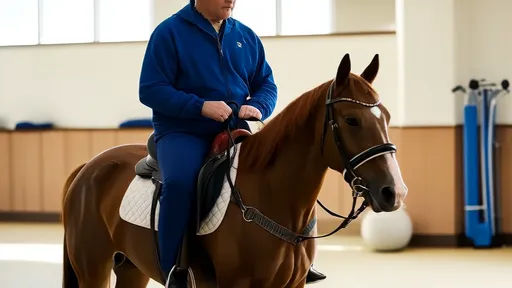
The rhythmic cadence of hooves against soft earth takes on new significance at therapeutic riding centers worldwide, where Parkinson's disease patients are discovering an unconventional ally in their battle against mobility loss. Hippotherapy, derived from the Greek word "hippos" meaning horse, has emerged as a promising intervention for gait rehabilitation, leveraging the horse's multidimensional movement to recalibrate the human nervous system. This ancient practice, now refined through modern neuroscience, offers a compelling alternative when pharmaceutical approaches reach their limits.
At the core of hippotherapy's effectiveness lies the horse's unique biomechanics. A horse's pelvis mimics the human gait with remarkable precision, generating three-dimensional movements that transfer to the rider at approximately 100 repetitions per minute. For Parkinson's patients experiencing festination (involuntary acceleration of steps) or freezing episodes, this consistent rhythmic input helps rebuild neural pathways damaged by dopamine depletion. The warmth and vibration of the horse's body provide additional sensory stimulation, often awakening dormant motor functions in ways that clinical treadmill training cannot replicate.
The therapy's impact extends beyond physical mechanics. Researchers have documented measurable changes in brain activity during equine-assisted sessions, particularly in the basal ganglia and cerebellum - regions most affected by Parkinson's. The necessity to constantly adjust posture in response to the horse's movement creates a form of "dynamic mindfulness," forcing the brain to reengage with bodily awareness that typically deteriorates with disease progression. Many patients report improved proprioception lasting hours or even days after dismounting.
Clinical studies reveal particularly promising outcomes for mid-stage Parkinson's patients who retain some ambulatory capacity but struggle with postural instability. A 2022 longitudinal study published in the Journal of Neurologic Physical Therapy followed participants through six months of weekly hippotherapy sessions. Not only did researchers observe a 30% reduction in fall frequency, but gait analysis showed significant improvements in stride length and heel-to-toe foot placement - two critical markers of walking safety often compromised by Parkinson's.
What makes equine movement uniquely therapeutic is its inherent variability. Unlike mechanized gait trainers that produce identical motions, each horse offers subtle differences in tempo and amplitude, challenging riders to adapt continuously. This natural unpredictability proves invaluable for addressing the start hesitation and freezing that plague Parkinson's patients during real-world navigation. Therapists often incorporate cognitive tasks like counting strides or identifying colored cones during riding, building dual-task capacity that translates directly to daily activities like walking while conversing.
The emotional dimension of hippotherapy contributes equally to its efficacy. Dopamine production, already impaired in Parkinson's, responds positively to pleasurable experiences. The bond formed between patient and horse triggers neurochemical changes that may enhance motor learning. Clinicians note that patients frequently attempt movements on horseback they would refuse in traditional therapy settings, propelled by what one physical therapist describes as "the equine invitation to motion." This psychological component proves particularly valuable for patients experiencing kinesia paradoxa - the phenomenon where emotional stimuli briefly override movement blockages.
Practical implementation requires careful calibration. Certified hippotherapists adjust variables including horse selection (from steady draft breeds to more animated quarter horses), session duration, and complementary exercises to match each patient's needs. Some centers incorporate vaulting techniques (gymnastics on horseback) to challenge balance, while others focus on mounted stretching to combat rigidity. The therapy's adaptability allows customization for diverse manifestations of Parkinson's, from postural instability dominant subtypes to tremor-predominant cases.
As research methodologies advance, new technologies are quantifying hippotherapy's effects with unprecedented precision. Wearable inertial measurement units now track millimeter-level changes in trunk movement symmetry, while pressure-sensitive saddle pads analyze weight distribution patterns. These tools help demonstrate what patients have reported anecdotally for years - that the benefits often persist beyond the immediate session. Some studies suggest regular hippotherapy may slow certain aspects of disease progression by maintaining neural plasticity through intense, rewarding sensorimotor stimulation.
The future of Parkinson's rehabilitation may well involve integrating hippotherapy with emerging technologies. Several research teams are exploring how virtual reality headsets used during riding could amplify the therapy's cognitive benefits, while others investigate combining equine movement with real-time biofeedback systems. As our understanding of neuroplasticity deepens, this ancient partnership between human and horse continues to offer new hope for rebuilding what Parkinson's disease has eroded - one deliberate, hoof-fall-guided step at a time.
By /Aug 12, 2025

By /Aug 12, 2025

By /Aug 12, 2025

By /Aug 12, 2025

By /Aug 12, 2025

By /Aug 12, 2025
By /Aug 12, 2025
By /Aug 12, 2025
By /Aug 12, 2025
By /Aug 12, 2025

By /Aug 12, 2025
By /Aug 12, 2025
By /Aug 12, 2025
By /Aug 12, 2025

By /Aug 12, 2025

By /Aug 12, 2025

By /Aug 12, 2025
By /Aug 12, 2025
By /Aug 12, 2025
By /Aug 12, 2025