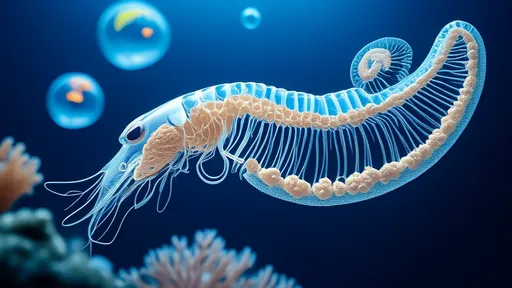
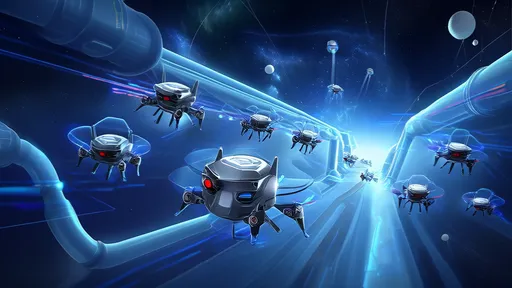
Inspired by the mesmerizing swarming behavior of Antarctic krill, researchers are now applying bio-inspired algorithms to solve complex challenges in drone swarm coordination. The krill herd algorithm (KHA), originally modeled after the collective movement patterns of these tiny crustaceans, has emerged as a particularly promising approach for enabling autonomous collision avoidance in unmanned aerial vehicle (UAV) formations.
The biological foundations of this approach lie in krill's sophisticated three-dimensional swarm intelligence. Unlike simple particle swarm optimization models, krill demonstrate advanced spatial awareness through density-dependent attraction-repulsion mechanisms. When translated into mathematical terms, these natural behaviors create a dynamic system where each individual maintains optimal positioning relative to neighbors while avoiding collisions - precisely the capability needed for drone formations navigating complex airspace.
Modern drone applications demand increasingly sophisticated coordination as urban air mobility and large-scale aerial deployments become reality. Traditional rule-based collision avoidance systems struggle with scalability in dense formations, often creating computational bottlenecks. The krill-inspired model offers distinct advantages through its emergent properties - simple individual behaviors collectively generating robust group-level intelligence without centralized control.
The algorithm implementation involves several biological parallels. Each drone, analogous to a krill individual, continuously evaluates its environment through virtual sensors measuring neighbor density, relative velocities, and proximity thresholds. These inputs feed into three key behavioral components: movement induced by neighboring drones, foraging activity (translated as target-seeking behavior), and random diffusion that prevents deadlock situations. The continuous interplay between these forces creates fluid, adaptive formations.
Field tests have demonstrated remarkable resilience in challenging scenarios. When 32 drones were deployed in a constrained urban canyon environment using the KHA model, the formation autonomously reconfigured around unexpected obstacles while maintaining communication links. The system exhibited particular strength in high-density situations where conventional potential field methods often fail due to local minima problems. Researchers noted the algorithm's inherent scalability - performance actually improved with additional drones up to a critical density threshold.
One unexpected benefit emerged in energy efficiency metrics. The krill-inspired model reduced average power consumption by 18-22% compared to leader-follower architectures in prolonged missions. This stems from the distributed decision-making process where each drone makes minor, continuous adjustments rather than executing frequent large maneuvers in response to a central controller's commands.
The military sector has shown particular interest in this biomimetic approach. Swarm tactics requiring rapid formation changes - such as envelopment maneuvers or adaptive sensor arrays - benefit from the algorithm's emergent properties. Unlike pre-programmed formation patterns, KHA-enabled drones can spontaneously reorganize based on threat detection while maintaining safe separation distances. Recent simulations show such systems could potentially coordinate hundreds of drones in contested electromagnetic environments where centralized control proves vulnerable.
However, significant challenges remain before widespread adoption. The stochastic elements in the krill algorithm, while beneficial for avoiding local optima, create predictability concerns in regulated airspace. Aviation authorities require deterministic behavior for certification, prompting ongoing research into hybrid approaches that maintain the algorithm's adaptive advantages while meeting strict safety standards. Additionally, the model's computational demands currently limit applications to drones with substantial onboard processing capabilities.
Future developments may draw from deeper biological insights as marine biologists continue decoding krill swarm dynamics. Early-stage research incorporates phytoplankton distribution patterns (modeled as mission waypoints) that influence krill movement - an approach that could allow environmental factors to naturally shape drone formations. Other teams are experimenting with evolutionary algorithms to optimize the numerous parameters in the KHA model for specific operational scenarios.
The intersection of marine biology and aerospace engineering continues to yield surprising synergies. As drone operations scale beyond human operators' direct control, nature-inspired solutions like the krill herd algorithm offer a compelling path toward truly autonomous, self-organizing aerial systems. The next decade may see these biomimetic principles become standard in everything from delivery drone fleets to planetary exploration rover teams.
By /Aug 12, 2025

By /Aug 12, 2025

By /Aug 12, 2025
By /Aug 12, 2025
By /Aug 12, 2025
By /Aug 12, 2025
By /Aug 12, 2025
By /Aug 12, 2025
By /Aug 12, 2025
By /Aug 12, 2025
By /Aug 12, 2025
By /Aug 12, 2025

By /Aug 12, 2025
By /Aug 12, 2025
By /Aug 12, 2025

By /Aug 12, 2025

By /Aug 12, 2025

By /Aug 12, 2025
By /Aug 12, 2025

By /Aug 12, 2025